

Disclaimer: This blog is a condensed adaptation of ideas presented in a paper recently published in Industrial & Engineering Chemistry Research (I&EC Research). Subscribers can access the full paper here.
As AI adoption accelerates across process industries, an important question is emerging: How much of traditional engineering modeling can be replaced by data-driven approaches?
The answer is less than many might expect.
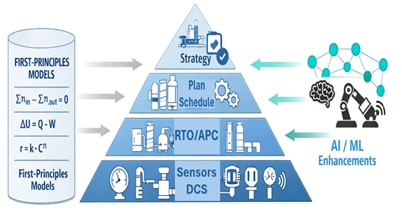
Artificial intelligence is creating enormous value in industrial operations. Machine learning is improving predictive maintenance, anomaly detection, forecasting and operational decision-making. Yet the systems that design, operate and optimize industrial facilities still depend on something fundamental: first-principles engineering.
For decades, first-principles models have formed the foundation of industrial automation and optimization. Built on the laws of physics and chemistry, and the rigor of mathematics, these models support process simulation, advanced process control, real-time optimization, production optimization, planning, scheduling and supply chain decision-making. They provide the physical consistency, transparency and reliability required in environments where safety, profitability and explainability are critical.
AI brings tremendous strengths to this landscape. Data-driven models can identify patterns, uncover hidden relationships and generate predictions at speeds that were previously impossible. Applications such as predictive maintenance, soft sensing, process monitoring and anomaly detection have already demonstrated significant business value.
However, industrial environments rarely present ideal conditions for purely data-driven approaches.
Processes evolve. Equipment ages. Feedstocks change. New operating targets emerge. Market conditions shift. When machine learning models encounter situations outside the operating space represented in their training data, performance can deteriorate. In some cases, they may generate recommendations that are difficult to explain, physically infeasible or operationally impractical.
This is where first-principles models continue to provide a unique advantage.
Because they are grounded in physical laws, first-principles models can often provide reliable predictions beyond observed operating conditions, provided their underlying assumptions and physical relationships remain valid. They enforce mass balances, energy balances, thermodynamic consistency and operational feasibility. Just as importantly, engineers can understand why they produce a particular result.
The value of first-principles models extends far beyond process simulation. They continue to underpin the entire industrial decision stack, from advanced process control and real-time optimization to production planning, scheduling and enterprise-wide optimization. Across every layer, AI is enhancing decision-making, but foundational engineering models remain the source of physical consistency and operational trust.
The most promising path forward is not choosing between physics and AI. It is combining them.
Digital twins provide a good example. Whether implemented as simple engineering estimators or comprehensive process models, digital twins provide a physics-based and data-calibrated view of equipment and process performance. When combined with machine learning, they become more effective at identifying degradation, detecting failures and supporting proactive maintenance decisions.
Similarly, reduced-order and surrogate models capture the essential behavior of complex industrial systems while providing the speed required for real-time optimization, planning and scheduling. Organizations gain faster decision-making capabilities without sacrificing the engineering principles that ensure realistic and actionable outcomes.
Physics-informed neural networks represent another significant advancement. By embedding physical laws directly into the learning process, these models improve data efficiency while maintaining consistency with engineering constraints. They demonstrate how AI and engineering can work together rather than compete with one another.
Even large language models have an important role to play. Emerging applications include flowsheet generation, engineering documentation, knowledge retrieval, optimization support and engineering workflow assistance. Yet these systems do not inherently understand thermodynamics, conservation laws or process constraints. Their output still requires engineering validation and domain expertise.
Industrial organizations have always embraced technologies that improve performance. AI is no exception. But the companies that realize the greatest benefit will be those that recognize a simple truth: industrial intelligence is most powerful when it is grounded in engineering fundamentals.
First-principles models remain the backbone of safe, reliable and economically optimized operations. AI extends their reach, improves their adaptability and accelerates insight generation.
The future of industrial automation and optimization lies not in the replacement of first principles by AI, but in their synergistic integration. Together, they will enable the next generation of intelligent, safe, sustainable and autonomous industrial systems.


Leave A Comment